The work
- Review the brief, available material and exhibition requirements.
- Study historical, scientific and visual sources relevant to the subject.
- Identify gaps, interpretive assumptions and questions to explore with specialists.
Exhibit Design, Modelmaking & Creative Fabrication
Research · Design · Making
From investigating a subject to developing the design and making it. Research, artistic interpretation and material work belong to the same process.
The process is modular. We can develop an early idea, join a project already underway or take responsibility for a specialist component. Stages, responsibilities, reviews and deliverables are agreed for each commission.
Five stages / Explore the process
01 / Sources, content and constraints.
What do we know, what needs to be understood, and what should the audience be able to grasp?
Discussion with curators, researchers and project leads helps establish which aspects are documented and which require interpretation. Specialist knowledge guides decisions while keeping the visitor's experience in view.
Research informs proportions, relationships and narrative choices. A convincing form needs content that stands up to close examination.
Drawings, samples and conversations give the process a clear rhythm. Clients can follow how an intention becomes a practical solution.
Manual techniques and digital tools belong to the same workshop. Their combination follows the form, scale and outcome the project needs.
Capabilities / Fields of practice
The subject shapes the design. The tools follow from it.
Physical reconstructions that help people understand a place, a building or a historical transformation. We work with curators, researchers and exhibition designers to connect evidence, interpretation and making.
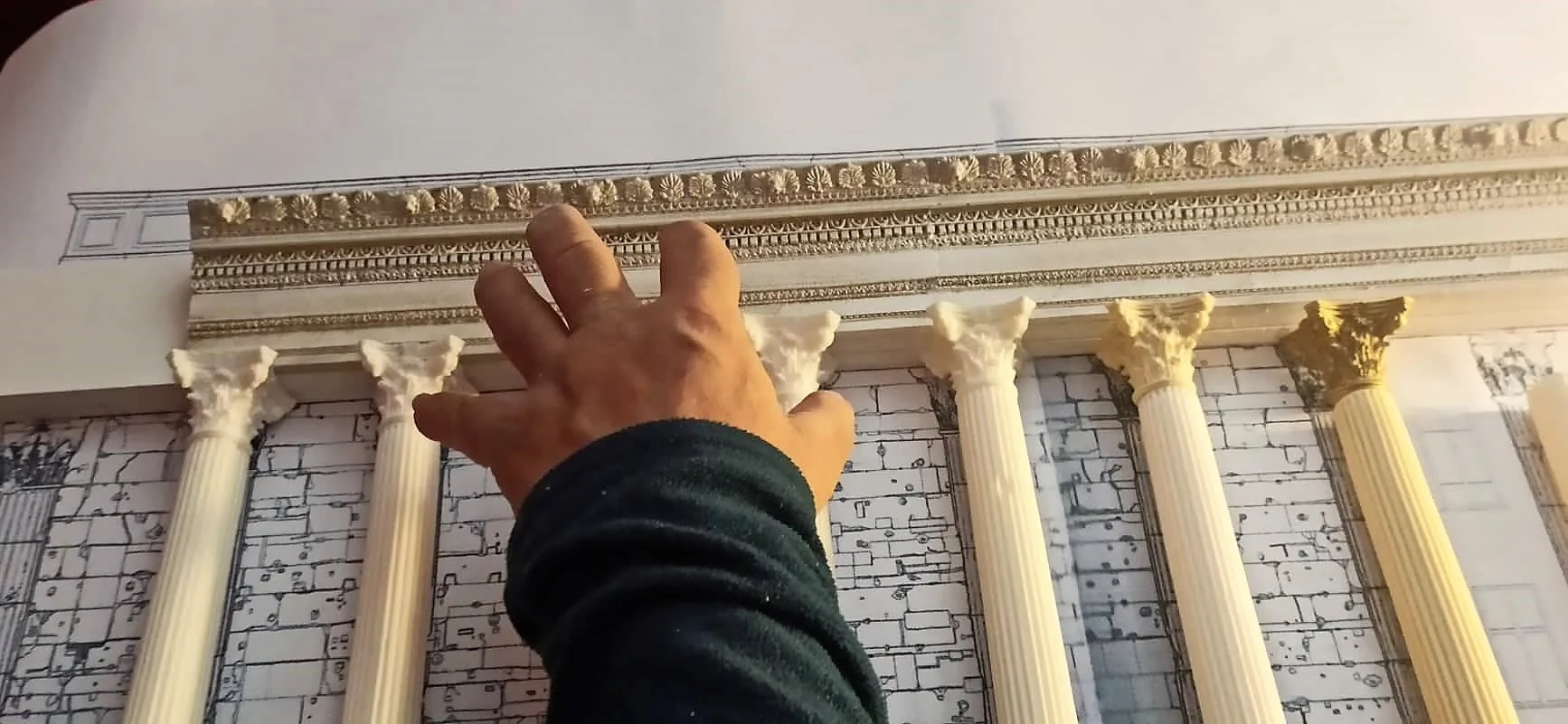
We begin with the material available: plans, images, surveys and scientific guidance. Scale, viewing distance and the visitor’s question shape the model. Details are resolved in relation to the overall story, with research assumptions discussed with the project team.
Museums, heritage sites, interpretation centres, curatorial teams and exhibition practices.
Work in this fieldModels and demonstration devices for ideas that are difficult to see directly. Scientific understanding, an audience’s curiosity and the behaviour of materials all inform the design.
We identify the principle the audience should grasp and the physical action that can reveal it. Development can include a working prototype to assess clarity, repeatability and practical constraints before the final object is made.
Science centres, museums, research institutions, educators, exhibition designers and production teams.
Work in this fieldModels that give architectural and design ideas a physical presence. From the reading of a complex building to a carefully finished presentation piece, form and purpose develop together.
We agree what the model needs to communicate, then develop a suitable scale, material language and level of detail. Manual craft and contemporary tools are selected around the work, from structural assembly to surface and sculptural finish.
Architects, designers, cultural institutions, artists, brands and collectors with a defined project.
Work in this fieldA specialist contribution to a larger creative project, or a complete physical work developed from the first brief. We collaborate with design practices, exhibition teams and artists, defining responsibilities and interfaces early.
The studio is led directly by Giuseppe and Gerardo. For larger scopes, the working team can expand around the skills the project requires. Production, specialist partners, transport and on-site integration are defined in the proposal rather than assumed.
Exhibition designers, architects, creative studios, contractors, artists and project teams seeking specialist expertise.
Work in this fieldThe approach in practice
A reconstruction of life between the late Bronze Age and early Iron Age, developed from excavation studies and further research into the wider context of the Italian peninsula.
Gerardo developed the village design and proposed reconstructions of its dwellings. These interpretations were reviewed and approved by the project's archaeologist.
The design encompassed houses, figures, vegetation and animals, studied as parts of a coherent and legible whole.
Alongside the village model, a separate stratigraphic reconstruction and an opening house revealing its interior offered different levels of access to the subject.
Gerardo also designed the individual figures. Working with Giuseppe, he carried the work through printing, painting and construction of the model.
Design and interpretation: Gerardo Isoldi. Fabrication: Gerardo and Giuseppe Isoldi. Interpretations approved by the project's archaeologist.
Your starting point
A subject to explore, a concept to develop or a project looking for its physical form: an initial conversation helps identify where we can contribute.
Let's talk